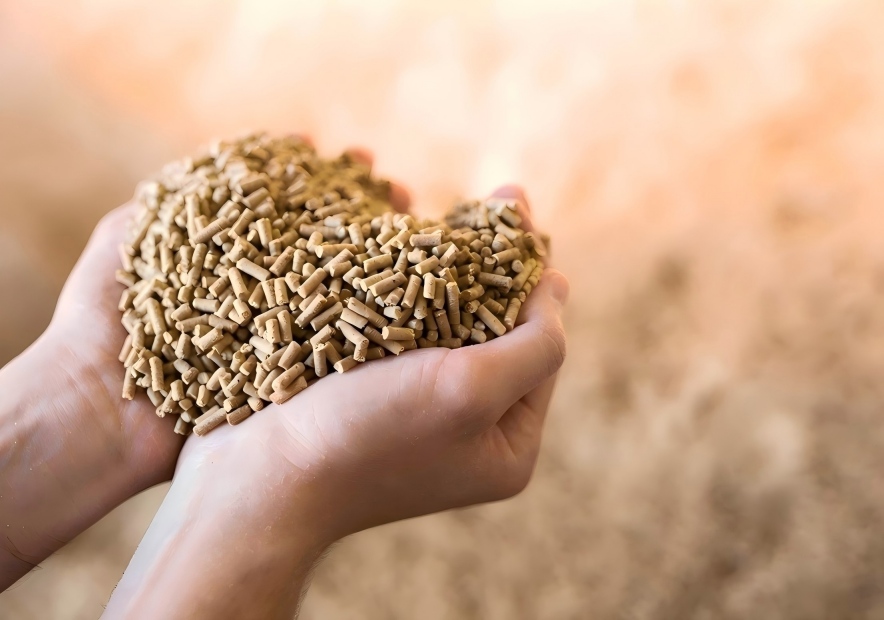
Modern cattle feed production technology refers to the integrated methods, equipment, automation systems, and quality-control processes used to transform grains, forage, protein meals, agricultural byproducts, minerals, and other ingredients into nutritionally balanced cattle feed. Unlike traditional feed preparation, which often relies on manual weighing and simple mixing, modern cattle feed production focuses on precision, consistency, production efficiency, pellet quality, and process control.
With the development of dairy farming, beef cattle production, and commercial livestock operations, the demand for professionally processed cattle feed has increased. Farmers and feed manufacturers need feed that is not only nutritionally appropriate but also easy to transport, store, handle, and distribute. Modern processing technologies help achieve these objectives by controlling every major stage from raw material receiving to finished-feed packaging.
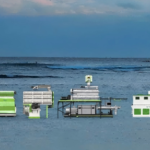
A modern cattle feed plant may include raw material cleaning equipment, hammer mills, batching systems, mixers, conditioners, pellet mills, coolers, vibrating screens, coating systems, packing machines, conveyors, elevators, and automated control systems. The exact configuration depends on the raw materials, feed formula, required capacity, pellet size, factory layout, and degree of automation.
Understanding modern cattle feed production technology is therefore important for anyone planning to establish a cattle feed factory, upgrade an existing facility, or select suitable cattle feed processing equipment.
What Does Modern Cattle Feed Production Technology Mean?
Modern cattle feed production technology is not a single machine or processing method. It is a complete production system designed to consistently produce feed according to a specific nutritional and physical specification.
A typical production process may include:
- Raw material receiving
- Cleaning and impurity removal
- Crushing or grinding
- Ingredient batching
- Mixing
- Steam conditioning
- Pelletizing
- Cooling
- Screening
- Optional coating
- Automatic weighing and packaging
- Storage and distribution
Different cattle feed products may require different processing configurations.
For example, concentrate cattle feed may contain large proportions of corn, barley, wheat bran, soybean meal, and other ingredients. Roughage-based feed may contain alfalfa, grass hay, straw, or other high-fiber materials. TMR-related products can have another combination of ingredients and processing requirements.
Therefore, modern cattle feed production technology emphasizes customized process design rather than using exactly the same equipment for every formula.
Why Is Modern Feed Production Technology Important?
Cattle feed quality depends on both formulation and processing.
A nutritionally balanced formula will not necessarily produce a consistent final product if ingredients are poorly measured, insufficiently mixed, improperly conditioned, or inadequately pelletized.
Modern processing technology helps control these factors.
The major objectives include:
- Improving ingredient uniformity
- Controlling particle size
- Increasing batching accuracy
- Improving mixing consistency
- Producing durable pellets
- Reducing fines
- Controlling feed moisture
- Improving storage stability
- Reducing manual operation
- Increasing production efficiency
- Supporting consistent product specifications
For commercial feed manufacturers, consistency is particularly important. Customers expect different batches of the same feed product to maintain similar physical characteristics and nutritional specifications.
Raw Materials Used in Modern Cattle Feed Production
Modern cattle feed plants can process a wide range of raw materials.
Common energy sources include:
- Corn
- Barley
- Wheat
- Sorghum
- Broken grains
Protein sources may include:
- Soybean meal
- Sunflower meal
- Cottonseed cake
- Rapeseed meal
- Other oilseed meals
Fiber sources may include:
- Alfalfa
- Grass hay
- Straw
- Silage-related materials
- Other forage resources
Additional ingredients can include:
- Wheat bran
- Rice bran
- Molasses
- Mineral mixtures
- Salt
- Vitamin premixes
- Approved feed additives
The characteristics of these ingredients can vary considerably. Corn and barley behave differently from alfalfa or straw during grinding and pelleting. Molasses can affect material flow because of its sticky characteristics.
Consequently, equipment selection should be based on the actual feed formula and raw material characteristics.
1. Raw Material Receiving and Storage
The production process begins with receiving raw materials.
Large feed factories may receive grains, meals, forage, and other ingredients in bulk. The materials need to be unloaded, transported, and stored efficiently before entering production.
Storage systems can include silos, warehouses, bins, hoppers, and conveyors.
Proper storage is important because raw material quality directly affects finished-feed quality. Moisture, contamination, improper storage conditions, and long storage periods can all affect ingredient performance.
A modern plant may also use separate storage systems for different ingredients to prevent cross-contamination and simplify batching.
2. Raw Material Cleaning
Cleaning is an important preliminary stage.
Incoming raw materials may contain stones, metal particles, dust, fibers, packaging fragments, or other foreign materials. Cleaning systems remove these impurities before the ingredients enter the main processing equipment.
Typical equipment may include:
- Cleaning screens
- Magnetic separators
- Aspirators
- Pre-cleaners
- Destoners
Cleaning improves material quality while also protecting downstream machinery.
For example, removing metal particles before grinding can help reduce the risk of damage to a hammer mill. Removing stones and other hard impurities can also reduce wear on processing components.
Therefore, cleaning contributes to both feed quality and equipment protection.
3. Grinding Technology
Grinding is one of the most important steps in modern cattle feed production.
Large grains and other raw materials may need to be reduced to a suitable particle size before mixing and pelleting.
Hammer mills are widely used for this purpose.
The target particle size depends on the feed formula and production requirements. The objective is not simply to grind ingredients as finely as possible. Excessive grinding can increase energy consumption, while particles that are too coarse may reduce mixing and pellet quality.
Proper grinding can provide several benefits:
- More uniform particle size
- Better mixing
- Improved pellet formation
- Reduced ingredient separation
- More stable pellet production
For high-fiber materials, the grinding process may require specialized equipment and suitable screen configurations.
4. Automated Batching
Once raw materials have been prepared, they must be weighed according to the feed formula.
Traditional feed production may rely heavily on manual weighing. Modern cattle feed factories increasingly use automated batching systems.
A batching system can control the quantity of individual ingredients according to a predefined formulation.
For example, a formula may contain a specific percentage of corn, barley, soybean meal, wheat bran, mineral premix, and other ingredients. The batching system weighs each component before it enters the mixer.
Accurate batching helps maintain consistent nutritional composition from one batch to another.
It also reduces manual errors and makes it easier to switch between different cattle feed formulas.
5. High-Efficiency Mixing
After batching, ingredients need to be mixed thoroughly.
The objective of mixing is to distribute all components evenly throughout the feed mixture.
This is especially important for micro-ingredients such as vitamins, minerals, and premixes. If mixing is inadequate, different portions of the final feed may contain different concentrations of these ingredients.
Modern mixers are designed to achieve uniform distribution within a controlled mixing time.
Important factors include:
- Mixer design
- Filling level
- Mixing time
- Ingredient sequence
- Particle size
- Moisture level
- Formula characteristics
A good mixing process creates a consistent material for the downstream pelletizing process.
6. Steam Conditioning
Conditioning is a key feature of many modern cattle feed pellet production lines.
Before entering the pellet mill, the feed mixture may be exposed to steam in a conditioning chamber.
The steam introduces heat and moisture into the feed material. This helps soften particles and prepare the mixture for compression.
Proper conditioning can improve pellet quality and pellet mill performance.
Potential benefits include:
- Better particle binding
- Higher pellet durability
- Improved pellet formation
- Reduced fines
- More stable production
- Improved processing efficiency
The conditioning parameters should be adjusted according to the feed formula.
Grain-based formulas may respond differently from high-fiber cattle feed. Therefore, conditioning should be considered part of the overall process design rather than a fixed setting.
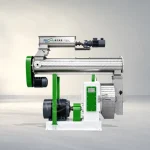
7. The Role of a Cattle Feed Pellet Making Machine
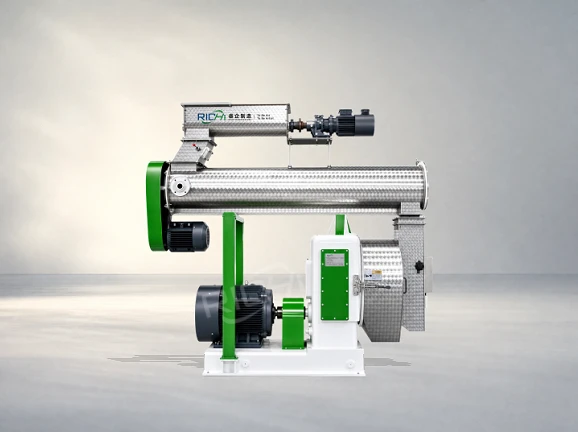
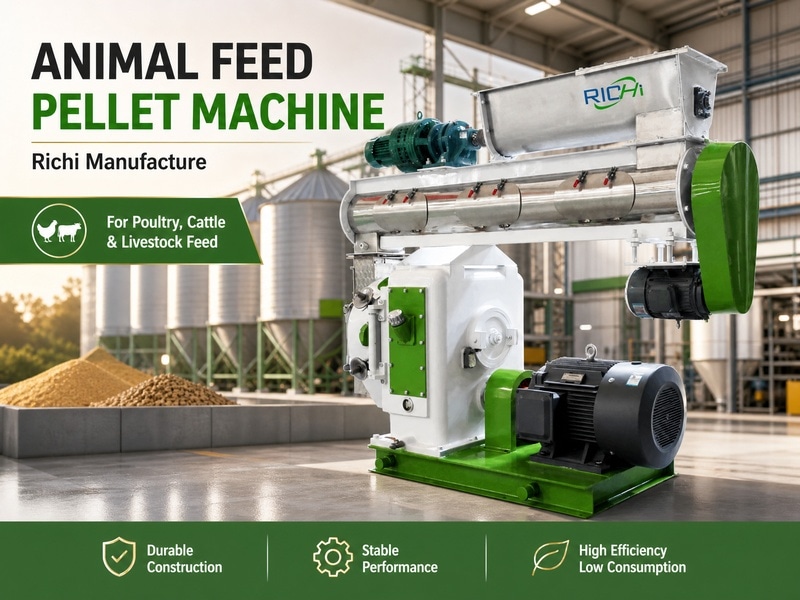
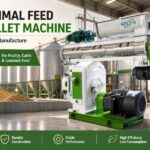
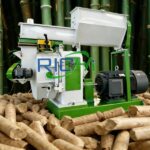
A cattle feed pellet making machine is one of the core machines in many modern cattle feed production lines.
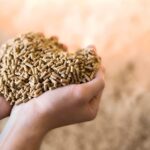
The machine compresses prepared feed material through a die to form cylindrical pellets of a specified diameter.
Pelletizing changes the physical characteristics of the feed while combining many individual ingredients into a compact product.
A suitable pellet machine should be selected according to:
- Feed formula
- Raw material characteristics
- Production capacity
- Pellet diameter
- Required automation
- Operating conditions
- Maintenance requirements
The die and roller system is particularly important because these components directly participate in the compression and pellet-forming process.
A high-quality cattle feed pellet making machine should provide stable operation and consistent pellet formation under the required production conditions.
For commercial cattle feed factories, pellet mill capacity should also match upstream and downstream equipment. If the pellet mill has a much higher capacity than the mixer, it may not receive enough prepared material. If the pellet mill is too small, it may become a production bottleneck.
This is why pelletizing equipment should be selected as part of the complete production line.
(Learn more:https://richipelletizer.com/cattle-feed-pellet-mill-for-sale/)
8. Ring Die Pelletizing Technology
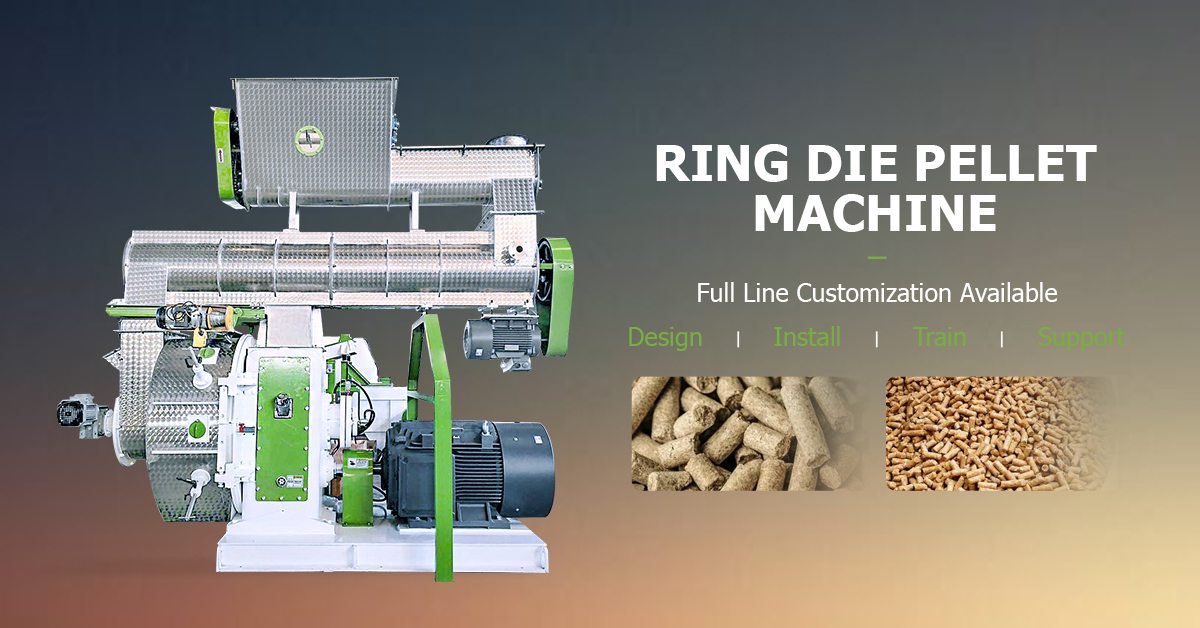
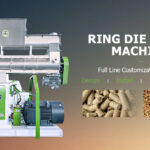
Commercial cattle feed plants commonly use ring die pellet mills for medium- and large-scale production.
During operation, prepared feed enters the pellet mill and is compressed between the rollers and the rotating die. The material passes through die holes and forms continuous strands that are cut into pellets.
The die hole diameter determines the approximate pellet diameter.
Different cattle feed formulas may require different compression ratios. High-fiber materials can behave differently from grain-based formulas, so die configuration should be selected according to the formula.
A well-designed ring die system can support stable, continuous pellet production when operated within its intended conditions.
9. Pellet Size Control
Pellet size is an important part of modern cattle feed production.
The appropriate diameter depends on factors such as:
- Cattle age
- Animal category
- Feed formulation
- Feeding system
- Customer requirements
For example, young cattle may require smaller pellets than mature cattle. Beef and dairy feed products may also have different specifications.
Modern pellet mills can use different dies to produce different pellet diameters.
Controlling pellet size improves product consistency and makes the finished feed easier to use in automated or semi-automated feeding systems.
10. Cooling Technology
Fresh pellets leave the pellet mill at a relatively high temperature and may contain excess moisture.
They therefore need to be cooled before screening and packaging.
A pellet cooler uses controlled airflow to remove heat and moisture from the pellets.
Cooling is important because warm pellets can create condensation problems during storage if they are packaged before reaching suitable conditions.
Proper cooling helps:
- Stabilize pellets
- Reduce moisture
- Lower product temperature
- Improve storage characteristics
- Reduce pellet breakage
- Prepare feed for packaging
The cooler capacity should be matched to the pellet mill output.
11. Screening and Fines Separation
After cooling, pellets are usually screened.
A vibrating screen separates qualified pellets from fines and broken particles.
High-quality pellets can continue to packaging, while unsuitable particles can potentially be returned to the production process depending on the plant design.
Screening helps ensure that customers receive a more consistent finished product.
It also reduces the amount of dust and fines in packaged feed.
For large commercial plants, efficient screening can contribute significantly to final product quality.
12. Liquid Coating Technology
Some modern cattle feed plants use coating equipment to apply liquid ingredients after pelleting.
Depending on the formula, these may include oils, certain nutrients, flavors, or other approved liquid ingredients.
Applying selected ingredients after pellet cooling can help protect components that may not be suitable for exposure to the temperature and pressure conditions of pelleting.
A coating system can also improve formulation flexibility.
The exact coating method should always be determined by the feed formulation and the technical characteristics of the ingredients.
13. Automated Packaging
Once the pellets have passed final quality control, they can be packaged.
Modern packing systems can automatically:
- Weigh the feed
- Fill bags
- Correct the weight
- Seal bags
- Convey finished bags
- Prepare them for palletizing or storage
Automation improves weighing accuracy and reduces repetitive manual labor.
For commercial feed manufacturers, automated packaging also helps standardize product presentation and improve production efficiency.
14. Centralized Electrical Control
A modern cattle feed factory often uses a centralized control system.
The operator can monitor equipment such as crushers, batching systems, mixers, pellet mills, coolers, screens, and packing machines through a central control panel.
Depending on the system design, automation can manage:
- Ingredient dosing
- Equipment sequencing
- Motor operation
- Production parameters
- Alarm systems
- Production records
- Safety interlocks
Centralized control reduces unnecessary manual intervention and allows operators to identify abnormal conditions more quickly.
15. Quality Control in Modern Cattle Feed Production
Modern technology does not eliminate the need for quality control. Instead, it provides more opportunities to control quality systematically.
Quality checks may be performed at several stages.
Incoming Raw Materials
Inspect raw material cleanliness, moisture, particle size, and other relevant specifications.
Grinding
Monitor particle size and equipment performance.
Batching
Check whether ingredient quantities correspond with the formulation.
Mixing
Evaluate mixture uniformity.
Conditioning
Monitor moisture and temperature.
Pelleting
Check pellet size, durability, density, appearance, and production stability.
Cooling
Monitor final moisture and temperature.
Finished Feed
Inspect the final product before packaging and shipment.
This multi-stage approach helps identify problems early rather than waiting until the final product has already been produced.
16. Modern Technology and Feed Uniformity
Feed uniformity is one of the main objectives of modern processing.
Consider a formula containing corn, soybean meal, barley, wheat bran, minerals, and vitamins.
If ingredients are not properly mixed, different portions of the feed may have different nutrient concentrations.
Grinding creates more consistent particle sizes. Accurate batching controls ingredient quantities. Mixing distributes ingredients throughout the batch. Pelleting then binds many ingredients into compact particles.
Together, these technologies help reduce physical segregation and create a more uniform finished product.
17. Modern Technology and Pellet Durability
Pellet durability is another important quality characteristic.
During transport and handling, pellets are subjected to mechanical impact.
Weak pellets may break apart and create excessive fines.
Pellet durability is influenced by:
- Raw material characteristics
- Grinding
- Formula composition
- Moisture
- Conditioning
- Die selection
- Roller adjustment
- Cooling
- Screening
- Transportation
This demonstrates why pellet quality cannot be attributed to the pellet mill alone.
The entire production process must be coordinated.
18. Technology for High-Fiber Cattle Feed
High-fiber feed creates special processing challenges.
Alfalfa, grass hay, straw, and other forage materials have different physical characteristics from grains.
Their long fibers may affect material flow, grinding, mixing, and compression.
Modern production systems can address these challenges through appropriate bale breaking, chopping, crushing, drying when necessary, mixing, conditioning, and pelletizing.
The equipment configuration should be based on the percentage and type of forage in the formula.
For example, a feed containing a high proportion of alfalfa may require a different process from a concentrate feed containing mainly corn and soybean meal.
19. Processing Molasses and Other Sticky Ingredients
Molasses is commonly used in some cattle feed formulations because of its energy value and physical properties.
However, its sticky nature can create challenges during mixing and material handling.
Modern feed plants may use specialized liquid addition and spraying systems to distribute molasses more evenly.
Controlled addition can reduce localized accumulation and help maintain mixture uniformity.
The appropriate addition point depends on the formula and process design.
This is another example of why feed production technology needs to be adapted to individual formulas.
20. Energy Efficiency in Modern Cattle Feed Plants
Modern cattle feed technology also focuses on energy management.
Major energy-consuming processes include grinding and pelleting.
An efficient plant should select equipment according to the required production capacity rather than simply choosing the largest available machine.
Energy consumption can be influenced by:
- Raw material characteristics
- Grinding fineness
- Motor efficiency
- Pellet mill load
- Die configuration
- Conditioning efficiency
- Equipment layout
- Conveying distance
Efficient factory design can reduce unnecessary energy consumption while maintaining the required product quality.
21. Automation and Digital Monitoring
Automation is becoming increasingly common in commercial cattle feed production.
Digital systems can record production data and monitor equipment conditions.
For example, operators may be able to track:
- Batch quantities
- Production output
- Motor status
- Alarm conditions
- Equipment operating time
- Formula information
- Production records
Data-based management can help identify production bottlenecks and improve process control.
Higher automation can also reduce dependence on manual operation, although the appropriate automation level depends on the investment scale and operating requirements of each factory.
22. How to Design a Modern Cattle Feed Production Line
The design process should begin with an analysis of the customer’s requirements.
Important questions include:
What Feed Will Be Produced?
Determine whether the factory will produce concentrate feed, roughage pellets, mixed cattle feed, or multiple products.
What Are the Raw Materials?
Identify grains, protein meals, forage, agricultural byproducts, liquid ingredients, minerals, and additives.
What Is the Required Capacity?
Capacity determines the size and quantity of major equipment.
What Pellet Sizes Are Required?
The pellet mill and die system should support the required specifications.
What Level of Automation Is Needed?
Small facilities may use simpler control systems, while large factories may require centralized automatic control.
What Is the Available Factory Space?
Equipment layout should consider material flow, maintenance access, storage, worker movement, and future expansion.
A properly designed production line connects these factors into one coherent system.
23. Turnkey Solutions for Cattle Feed Production
For investors who are unfamiliar with feed processing technology, a turnkey engineering solution can simplify the project.
A turnkey supplier may provide services including:
- Production line design
- Equipment manufacturing
- Factory layout planning
- Equipment transportation
- Installation
- Commissioning
- Operator training
- Technical support
- Long-term after-sales service
The advantage of an integrated approach is that equipment selection and process design are considered together.
For example, the capacity of the crusher should correspond to the mixer and pellet mill. The cooler should be capable of handling the pellet mill output. The screening and packaging systems should also match the production capacity.
This coordination helps reduce production bottlenecks.
(Learn about turnkey cattle feed manufacturing plant cost)
24. Choosing Equipment for a Modern Cattle Feed Factory
When choosing cattle feed processing equipment, investors should evaluate the complete production process rather than focusing only on individual machine prices.
Important factors include:
Raw material compatibility: Equipment should be suitable for the actual ingredients.
Capacity: Machines should be properly matched to the target output.
Pellet specifications: The pellet mill should support the required diameter and product characteristics.
Automation: The control level should match production scale and labor availability.
Durability: Major wear components should be suitable for continuous industrial operation.
Maintenance: Easy access to key components can simplify routine maintenance.
Technical support: Installation, commissioning, training, and spare-parts support can be important for long-term operation.
Future expansion: The plant layout should ideally leave room for additional equipment or increased production.
25. The Future of Cattle Feed Production Technology
The development of cattle feed production technology is moving toward greater automation, process integration, energy efficiency, and production flexibility.
Future systems are likely to place greater emphasis on real-time production monitoring, automated formula management, intelligent equipment control, and data-based quality management.
At the same time, feed manufacturers will continue to use a broader range of agricultural resources and byproducts.
This means processing systems need to become increasingly flexible.
A modern feed factory should therefore be capable of handling different formulas while maintaining stable production conditions.
Conclusion
Modern cattle feed production technology is a complete system rather than a single piece of equipment. It combines raw material preparation, grinding, accurate batching, mixing, conditioning, pelletizing, cooling, screening, coating, packaging, automation, and quality control.
A cattle feed pellet making machine plays a central role in many of these production systems because it converts prepared feed mixtures into compact and uniform pellets. However, pellet quality depends on the performance of the entire production process, including raw material preparation, formula design, mixing, conditioning, cooling, and screening.
For cattle feed manufacturers and livestock producers planning a new feed factory, the most important consideration is to match the production technology to the actual raw materials, feed formulas, capacity, pellet specifications, factory space, and automation requirements.
A properly engineered cattle feed production line can provide consistent processing, stable pellet quality, efficient material handling, and more controlled production. By integrating suitable equipment with appropriate process technology and quality management, modern cattle feed factories can build a reliable production system capable of serving changing market and livestock feeding requirements.