


Direct answer: a pellet machine manufacturer’s workshop can reveal whether the supplier controls critical production processes, has the equipment and people to build the offered machine, uses traceable quality checks, and can handle project volume. It cannot alone prove ownership, annual sales, machine performance, or customer satisfaction. The best workshop review connects visible equipment and work in progress to drawings, job records, measurements, test results, and the exact proposal.
Start with flow, not floor area
A very large building can contain little relevant manufacturing, while a smaller factory can have a disciplined and efficient flow. Trace material from receiving through cutting, machining, welding, surface treatment, assembly, electrical work, testing, preservation, and shipment. Look for clear handoffs, identified work orders, controlled drawings, inspection points, and separation of conforming and nonconforming items.
Congestion is not automatically failure; factories vary with production stage. But repeated backtracking, unidentified parts, blocked access, mixed materials, and no visible inspection status can signal weak control. Ask how the layout prevents the wrong part or drawing revision from entering assembly.
Machining capability reveals control of critical geometry
Pellet mills depend on shafts, bearing fits, roller components, die interfaces, housings, and drive alignment. Ask which critical parts are machined in-house and which are sourced. Observe machine tools, fixtures, operator instructions, measuring instruments, and material identification. The brand and age of a machine tool matter less than whether the process can consistently hold required characteristics.
Request a redacted drawing for a selected work order, then ask the operator or inspector to show one critical measurement and its record. Confirm instrument range and calibration status. If the supplier claims tight tolerances but cannot identify the characteristic or measurement method, visible machinery does not prove capability.
Fabrication reveals engineering discipline
Frames, bases, hoppers, chutes, guards, and structures affect alignment, vibration, access, and durability. Inspect material preparation, welding sequence, fixtures, distortion control, procedure control, welder identification, visual inspection, and repairs. Ask how dimensions are checked before machining or assembly and how surfaces are prepared for coating.
A smooth paint finish can hide weak fabrication, while an unfinished workpiece may be in a valid production stage. Review evidence before judging appearance. For critical structures, ask what codes, calculations, or inspection methods apply to the project.
Assembly practices predict early-life reliability
Observe cleanliness, bearing handling, fastener control, alignment, lubrication, sealing, cable routing, and protection of machined surfaces. Ask how torque values are specified and recorded, how fits are verified, and how foreign material is prevented from entering gearboxes or bearings. A capable design can fail early through poor assembly.
Follow one machine’s traveler. It should identify model, serial number, parts, inspections, deviations, and release. Ask what happens when a component does not fit. A controlled factory records and resolves the cause; an uncontrolled factory may grind or modify parts without engineering approval.
Electrical and automation capability
If the supplier offers panels and controls, inspect panel design, component control, wire marking, terminal checks, software versions, alarm testing, interlocks, and backups. Determine whether panels are built in-house, by a controlled partner, or by an unrelated third party. Ask who owns the control narrative and who supports changes after commissioning.
Panel appearance is not enough. Match the panel to drawings and bill of materials. Simulate a sensor fault or emergency condition during factory acceptance. Confirm that the delivered configuration meets the destination approval route; generic component certificates do not establish complete-system compliance.
Testing capability needs defined objectives
No-load rotation can verify direction, noise anomalies, basic vibration, lubrication, and interlocks. It cannot prove output on the buyer’s material. A loaded factory test may examine feeding and pellet formation but may still be too short to establish wear, availability, or long-term quality. Ask what each test is intended to prove and what remains for site acceptance.
Review test instruments, calibration, data capture, acceptance values, deviations, and release authority. A test area with machines running is useful only when results are traceable to serial numbers and contractual requirements.
Warehouse evidence shows supply control
Inspect incoming identification, storage conditions, shelf life, segregation, issue records, and inspection status. Motors, bearings, seals, electrical components, lubricants, coatings, and instruments may require different storage. Ask how substituted components are approved and how counterfeit or incorrect parts are prevented.
A crowded warehouse can indicate business volume or poor management; a nearly empty one can indicate lean flow or lack of orders. Reconcile observations with production schedule and purchase records rather than making a visual assumption.
People are part of factory capability
Ask who performs process engineering, detailed design, machining planning, welding oversight, quality inspection, controls, commissioning, and service. Review role descriptions, training, and qualification relevant to the task. A factory may own excellent equipment but depend on a few overloaded engineers.
Interview technical staff without the salesperson answering every question. Ask them to explain a recent nonconformance, a difficult commissioning issue, or a design trade-off, with customer details removed. Credible teams explain boundaries and lessons; rehearsed claims often remain general.
What the supplied image can support
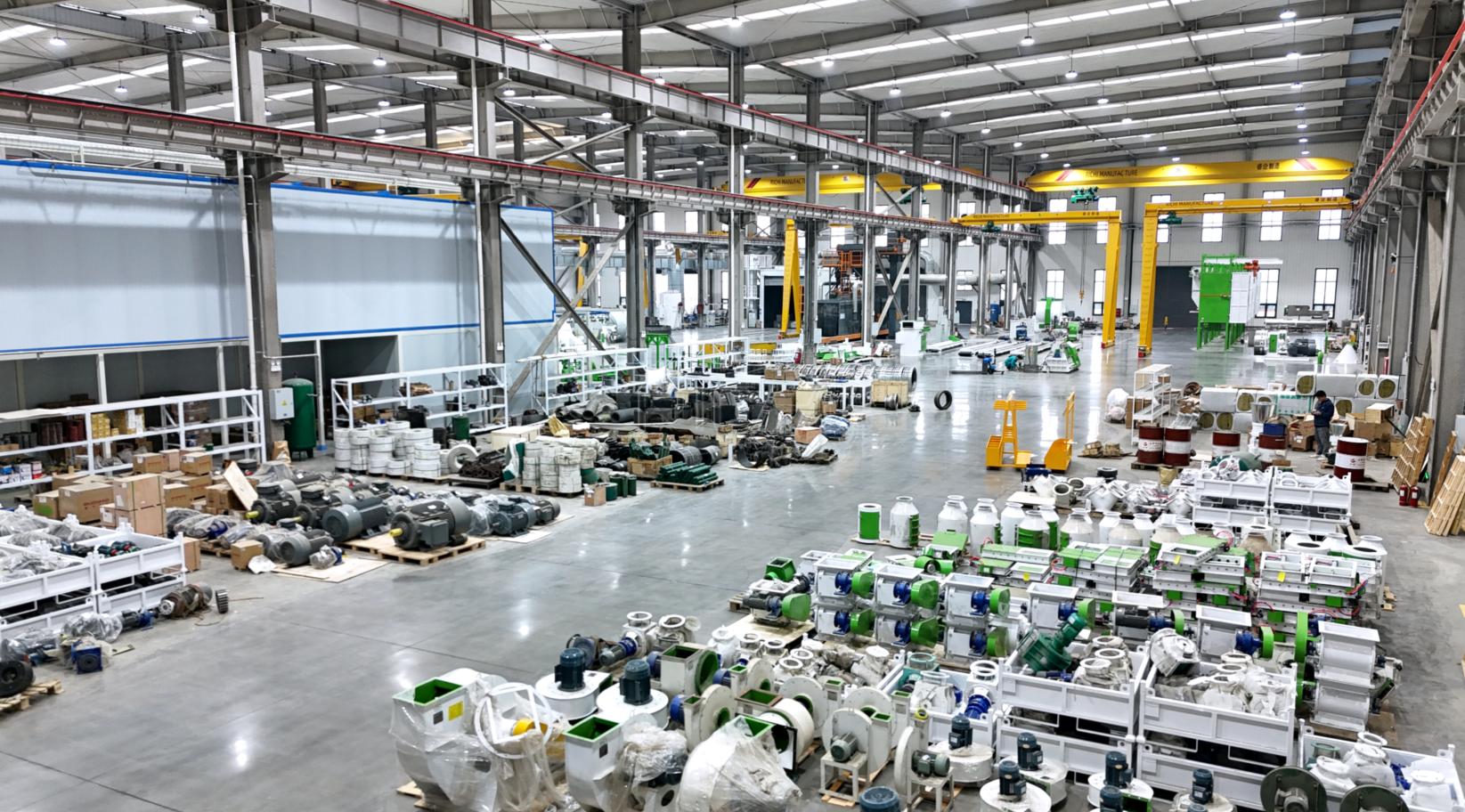
The photograph shows a broad manufacturing hall with many pellet-related machines and parts, overhead cranes, production zones, motors, and staff. It can support a statement that the photographed site contains relevant industrial equipment at the moment captured. It cannot prove who owns the building, how many machines are completed annually, which projects are genuine, or whether any item passed inspection.
This exact image is reused for several topics in the batch, so it should not be described differently to create artificial evidence. A workshop capability claim needs live observation and linked records beyond the photograph.
Capacity means demonstrated throughput through the factory
Ask for production planning by major resource: machining hours, welding bays, assembly positions, panel capacity, testing slots, and critical suppliers. Review current workload and the proposed project’s slot. Annual “number of machines” is meaningless unless models and complexity are comparable.
Look for bottlenecks. A factory may fabricate quickly but wait for gearboxes or motors. It may assemble many machines but have one test bay. Ask for long-lead items, normal and adverse lead times, and recovery plans. Capacity is the controlled flow of a complete order, not unused floor space.
Quality records to sample
- Approved drawing and revision history.
- Material certificate or incoming inspection for a selected part.
- Machining or dimensional inspection record.
- Welding and fabrication inspection where applicable.
- Assembly traveler and torque or alignment checks.
- Electrical inspection and software version.
- Nonconformance and corrective-action example.
- Factory test and final release record.
- Packing list and preservation checklist.
Signals of genuine capability
Strong evidence includes staff who can explain their process, consistent model and job identification, measuring instruments matched to characteristics, controlled deviations, work in multiple stages, serial-number traceability, and records that reconcile with the factory route. Weak evidence includes only finished display machines, no job identifiers, certificates unrelated to the legal entity, identical photos across brands, and refusal to show live production.
Outsourcing is acceptable when it is controlled
No factory needs to manufacture every motor, bearing, gearbox, sensor, or steel plate. The important distinction is between controlled supply and unknown resale. Ask how suppliers are approved, specifications are issued, incoming parts are inspected, changes are authorized, and failures are traced. For critical components, identify the actual manufacturer and model in the proposal.
When fabrication or panels are outsourced, visit or audit the partner if the package is critical. Confirm who owns drawings and software, who signs inspection records, and who provides warranty support. A well-controlled partner can improve quality; an undisclosed chain can make responsibility disappear.
Turn observations into a capability score
Score process ownership, engineering depth, production control, measurement, nonconformance handling, testing, schedule capacity, documentation, and supplier control separately. Use evidence grades: live observation plus record, record only, verbal explanation, or no evidence. Avoid one overall impression such as “modern factory.”
Weight the score to the project. A customized high-capacity line needs stronger engineering and integration. A standard replacement mill may emphasize model consistency, delivery, and parts interchangeability. A difficult biomass duty gives more weight to material testing, wear engineering, and references. The same workshop can be adequate for one order and inadequate for another.
Audit the link from sales to engineering
Give the salesperson’s promised capacity, material range, power, delivery, and customization list to the engineering team and ask them to confirm assumptions. Compare their answer with the quotation. Misalignment between sales and engineering is a common project risk even in a real factory.
Review how customer requirements become drawings and production orders. There should be a design review, approval status, revision control, and release authority. If production begins from an unapproved or outdated requirement, impressive machining capacity can manufacture the wrong equipment efficiently.
Look for learning, not a claim of zero defects
Ask for a redacted recent nonconformance and corrective action. Strong organizations can explain containment, root cause, correction, verification, and prevention. A claim that the factory never has defects is less credible than evidence that it detects and learns from them. This conversation often reveals more capability than a display machine.
Final interpretation
A manufacturer’s workshop tells you whether the visible organization appears able to execute the production steps it claims and whether those steps are controlled. It does not answer the whole supplier decision. Combine workshop evidence with legal verification, engineering review, references, financial and commercial diligence, and a model-specific acceptance test.
The strongest factory is not simply the largest or cleanest. It is the one where the buyer can follow a coherent chain from approved requirement to finished serial-numbered machine and see how the company detects, records, and corrects variation along the way.